exhaust Pitch deck GitHub
Build for the next builder · Fe Builders Challenge 2026

Your compiler refuses the sequence nobody wrote a test for.

Deposit, Deposit, Lock, Release, Refund: drop one condition and the escrow pays both sides. exhaust explores all 736 reachable states inside fe build, at capacity 21, in 940,335 of the compiler's 1,000,000 steps. Then the build names the broken invariant.

fe 26.6.0 (5b3f96a) · 28 EVM + 10 native tests · Apache-2.0

A model checker inside fe build: every reachable state of the escrow at capacity 21.

Escrow · reachable states · C = 21 Explored 736/736Patched build · invariant broken
736 reachable states as lamps, columns by breadth-first depth 0 to 43, 966 transitions as wires NEW (Settled,0,1,1)both sides paid
EXHAUSTED 736/736 · C=21BUILD FAILED · 'PAID ONCE' graph: evidence/state-graph-escrow.json
Main build · every invariant heldInvariant 'paid once' brokenROUTE 1·1·2·3·4
  1. Start
    (Open,0,0,0)
  2. 1Deposit
    (Open,1,0,0)
  3. 1Deposit
    (Open,2,0,0)
  4. 2Lock
    (Locked,2,0,0)
  5. 3Release
    (Locked,1,1,0)
  6. 4Refund
    (Settled,0,1,1)

Replay, slowed for the eye: lamps light in the search's breadth-first order, read from the committed graph. The new red lamp is a state the unpatched model never reaches.

736

reachable escrow states at capacity 21, each one checked against five named invariants.

evidence/bench-2026-11-20.md
940,335

of the 1,000,000 evaluator steps Fe 26.6.0 gives one static_assert. The ceiling is the design.

evidence/budget.md
9/9

bug patches that fail fe build, each naming its invariant and printing its route.

evidence/check-bugs.txt
25,646

handler calls replayed through 1,008 deployed contracts, each result compared with step().

evidence/differential.txt
Route setting · the 60-second demo

Drop one condition. Get one red build.

Change notice · src/escrow.feRefund guard
-  if s.escrow > 0 && s.seller == 0 {+  if s.escrow > 0 {
  1. fe build is green: at C = 21 the search held explore(CAP) == STATES with 736 states, the four state invariants on every state and the transition invariant on every accepted edge.
  2. Drop the seller check from the Refund guard. Nothing else in the ingot changes.
  3. The build fails. The compiler prints the invariant's message and the shortest route as action digits: 11234, Deposit, Deposit, Lock, Release, Refund.
sh demo/run.sh, 2026-11-20 23:19 UTC, commit de43ffc, fe: fe 26.6.0 (5b3f96a), Darwin arm64
== 1. fe build (the escrow, every reachable state at capacity 21 checked at compile time)   build OK: static_assert(explore(CAP) == STATES) held, STATES = 736, every invariant held on every reachable state and edge == 2. the bug: one line in the Refund guard (demo/refund-after-release.patch)   - if s.escrow > 0 && s.seller == 0 {   + if s.escrow > 0 { == 3. fe build again   error[3-0036]: assertion failed in const context   = assertion message: invariant 'paid once' broken: buyer and seller both paid   error[8-0081]: static assertion failed   = left: `11234`   -> build FAILED (as it must) 

Blocks 1–3 of sh demo/run.sh. Block 4 of the same run replays the route on the patched contract (all five calls accepted, both sides paid) and on the real one (the Refund refused, storage unchanged).

Six parts. The build is the checker.

The model is ordinary Fe, the checker is the compiler you already run, and the contract calls the function that was checked. A Python oracle, written separately, re-counts every pin.

A const fn walks the graph

Breadth-first search with while loops, mutable locals and array writes, evaluated by the compiler. Each successor is checked before it is encoded.

while head < tail {let x = queue[head]head += 1let cur = decode(x)var a: u32 = 0while a < ACTIONS {let act = action_of(a)let n = step(cur, act, cap)if n.ok {// Every invariant is checked before `encode`, so an out-of-box successor fails by name.let v = first_violation(cur, act, n.s, cap)if v != OK { require(v) }let y = encode(n.s)if !visited[y as usize] {visited[y as usize] = truequeue[tail] = ytail += 1}}a += 1}}
src/escrow_explore.fe:94–115
const fnwhilearray index writesFe ≥ 26.1.0

static_assert is the gate

Five core pins, each its own static_assert and its own budget (three shard pins follow at lines 270–274). If a count drifts, an edge hash changes or an invariant breaks on the way, fe build stops.

251explore(17) == 494254explore(CAP) == STATES258counterexample(19) == 0261or_deferred(fingerprint(CAP, false, STATES), EDGES) == EDGES262or_deferred(fingerprint(CAP, true, STATES), EDGE_HASH) == EDGE_HASH
src/escrow_explore.fe:251–262 · CAP = 21, STATES = 736, EDGES = 966
static_assertsharded, never chained

assert! names the rule

paid oncesettled emptyconservedwithin capacityin bounds

A failed const-context assert! prints its message as a compiler note; the route comes back as the left: side of a failed static_assert.

error[3-0036]: assertion failed in const context= assertion message: invariant 'paid once' broken: buyer and seller both paiderror[8-0081]: static assertion failed= left: `11234`
evidence/transcript-fail-refund-after-release.txt (excerpt)

One step(), three runs

736compile time
=
736Sonatina EVM
=
736native

The same explorer returns 736 at C = 21 (and 494 at C = 17) in the build and in test_runtime_explore_agrees on both backends. The EVM search at C = 17 burns 16,394,182 gas.

fe test --backend nativeblack_box

The contract replays every edge

25,646

handler calls through 1,008 deployments at C = 21; after each, ok and the stored state are compared with step().

contract · msg · recv

An oracle outside Fe

15/15

Fe pins matched by tools/ref_model.py, a stdlib Python model written separately, plus the 3,680-row edge table.

evidence/oracle.txt
exhaust architecture: src/escrow.fe holds step() and five named invariants; the compile-time explorer runs it under static_assert inside fe build, the contract's recv handlers call the same step() on Sonatina EVM, the runtime search also runs on native, and the tests replay every reachable edge through the deployed contract; demo patches to step() must turn fe build red; a Python oracle outside Fe checks every pinned count.
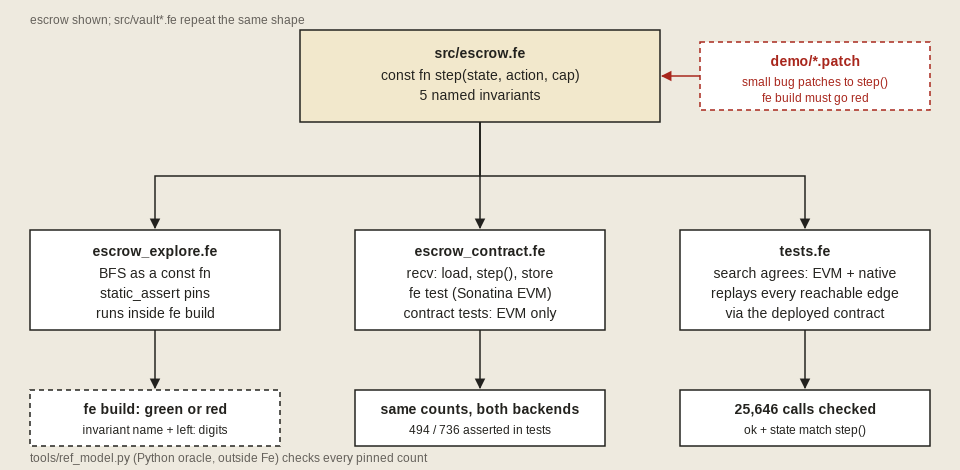
The whole build on one sheetOne step(), three executions, one oracle outside Fe. Escrow shown; the vault repeats the shape.docs/architecture.svgswipe the figure sideways →
The ceiling · stated on the first screen

One million steps. Then the build stops.

Fe 26.6.0 evaluates each static_assert with 1,000,000 steps and a recursion limit of 64, with no command-line or config override (machine.rs, lines 66–73 at v26.6.0). Every bar below was measured by loop bisection (bench/budget_probe.py).

0500,0001,000,000 · the wall
Escrow search, C = 21explore(CAP) · 736 states
940,335 · 94.0%
Route printer, C′ = 20counterexample(20) · fits
983,899 · 98.4%
Route printer in the build, C′ = 19counterexample(19)
908,455 · 90.8%
Vault search, B = 10, T = 3vexplore(VB, VT) · 211 states
586,715 · 58.7%
evidence/bench-2026-11-20.md §2 · evidence/budget.md · setting up the escrow's two tables and the start state costs 86,323 steps

Consts that reference other consts share one budget, so a bigger model is split across independent asserts, each with a fresh million. The 714 states after Lock (all but the 22 Open ones), as three shards by locked amount:

91 states
19.1% of one budget
238 states
36.3%
385 states
53.5%
Lever frame · second protocol

A 2-of-3 timelock vault. Pull any lever.

211 reachable states in one static_assert and 580 transitions in another, at balance 10 and lock period 3 (depth 0 to 70). The track repeats once per unit paid out. Each lever names one small patch from demo/ (one to three changed lines) and replays an excerpt of that patch's committed build output: each build fails with its own invariant and route.

Vault · reachable states · B = 10 · T = 3211 states · 580 wires
211 reachable states as lamps, columns by breadth-first depth 0 to 70, 580 transitions as wires PAID 0PAID 1PAID 2PAID 3PAID 4PAID 5PAID 6PAID 7PAID 8PAID 9
EXHAUSTED 211/211 · B=10 T=3BUILD FAILEDgraph: evidence/state-graph-vault.json
re-set from evidence/transcript-fail-vault-*.txt
# every lever is one patch to the vault's step(); the build must fail# legend 1 Propose · 2 ApproveA · 3 ApproveB · 4 ApproveC · 5 Tick · 6 Execute · 7 Cancel

Control table: nine patches, nine refusals.

A signal box's control table lists every route and what locks it out. This one lists every patch in demo/ and the rule that stopped it. sh demo/check-bugs.sh passes only when each patched build fails.

evidence/check-bugs.txt · action legends: escrow 1 Deposit · 2 Lock · 3 Release · 4 Refund · 5 Dispute; vault as above
No.PatchInvariant namedRoute (left:)Decoded
01refund-after-release'paid once'11234Deposit, Deposit, Lock, Release, Refund
02settle-early'settled empty'1123Deposit, Deposit, Lock, Release
03mint-release'conserved'123Deposit, Lock, Release
04cap-off-by-one'within capacity'11111111111111111111twenty Deposits
05vault-approve-twice'counted once'122Propose, ApproveA, ApproveA
06vault-execute-early'timelock respected'1236Propose, ApproveA, ApproveB, Execute
07vault-pay-twice'pays one unit'1235556Propose, ApproveA, ApproveB, Tick, Tick, Tick, Execute
08vault-cancel-pays'only execute pays'17Propose, Cancel
09vault-execute-unguarded'two distinct approvals'6Execute

Take Fe out and the checker is gone.

Since Fe 26.1.0 (changelog) a const fn may loop, keep mutable locals and write into arrays, and static_assert evaluates it during the build. That is the whole move: the search is ordinary Fe, the build is the checker, and the same step() is called by the contract's recv handlers and by fe test on Sonatina and native.

We did not compare this against other contract languages or model checkers. This page describes what this build does, not how it ranks.

  • const fn + while + array writessrc/escrow_explore.fe:94
  • static_assert as the build gatesrc/escrow_explore.fe:254
  • assert! message = named invariantsrc/escrow_explore.fe:41
  • contract · recv calling step()src/escrow_contract.fe:64
  • fe test on both backends · black_boxsrc/tests.fe:30
fe 26.6.0 (5b3f96a) · fe.toml ingot · fe fmt --check clean
Notice to drivers · honest by design

What this does not prove.

  • Only the stated capacities are explored (C = 21 for the state count, C′ = 19 for the printed trace); behaviour above them is not checked. Liveness is not checked, only safety invariants.— README · Limitations
  • The escrow model has no caller identity: msg.sender authorization is not modelled. Units are abstract counters: no ETH or token moves, so value transfer, reentrancy and gas are out of scope.— README · Limitations
  • MODEL.md, the Fe model and the oracle share one author and one reading of the protocol. … A misreading shared by all three is not caught.— README · Limitations (excerpt)

Questions a judge would ask.

Is this formal verification?

No. It is bounded-exhaustive checking: every reachable state of the model at the stated capacity (escrow C = 21, vault B = 10 with T = 3) is explored at compile time. Above the bound nothing is checked; the bet is the small-scope hypothesis, that most protocol bugs already show at small sizes. For the nine bugs we planted, the Python oracle (tools/ref_model.py) shows each one already breaking an invariant at escrow capacity 1 or 2, at vault balance 1 or 2 with T = 3, and at timelock 1 with B = 10 (evidence/small-scope.txt; at a small capacity the first invariant named can differ, as for mint-release). The demo route 11234 appears at capacity 2, the same digits the build's trace printer prints at C′ = 19 (evidence/check-bugs.txt). That illustrates the hypothesis on this zoo; it is not evidence about bugs nobody planted. C = 21 is how far one assert can count, not what the demo bug needs.

Why stop at capacity 21?

The state encoding holds at most 21 units (MAX_CAP = 21), and the C = 21 search already uses 940,335 of the 1,000,000 steps one assert may spend. The route printer runs at C′ = 19 (90.8%); C′ = 20 would still fit at 98.4%.

Can I raise the step budget?

Not in Fe 26.6.0: the limit is a constant in the compiler, with no flag or config. What works is splitting the search into independent asserts, each with its own million. Chaining consts does not help, because consts that reference other consts share one budget.

Is the deployed contract the code that was checked?

For the escrow, yes: its recv handlers call the same step(), and a differential test replays every reachable transition through deployed contracts (1,008 deployments, 25,646 handler calls), comparing ok and the stored state each time. The vault's caller and timelock checks are adapter code outside the compile-time check; the README lists exactly what is untested.

How does this relate to SMTChecker, Foundry, Echidna or halmos?

We did not benchmark against any of them. Solidity's compiler ships SMTChecker, which reasons symbolically with SMT and Horn solvers; Foundry invariant tests run random call sequences and check invariants after each call; Echidna generates random call sequences and checks that each invariant holds; halmos tests EVM contracts symbolically. exhaust is an explicit-state search in ordinary Fe: no solver, no annotation language, no random sampling. The compiler enumerates every reachable state at a stated capacity, over the same step() the contract calls.

Who checks the checker?

An independent reference model in plain Python (tools/ref_model.py, stdlib only) recomputes every count; it agrees with all 15 Fe pins and the 3,680-row escrow edge table. It shares the author and one reading of the protocol, which the limitations say plainly.

How do I reproduce it?

Install fe 26.6.0 (5b3f96a), then fe build, sh demo/run.sh, fe test and fe test --backend native. DEMO.md maps every number to its command; a clean clone on Linux x86-64 reproduces the build and both test runs; the native backend needs a C linker such as gcc with libc6-dev (evidence/repro-linux-2026-11-21.txt).

Clone it. Break it. Watch the build refuse.

# fe 26.6.0 (5b3f96a)
git clone https://github.com/edycutjong/exhaust && cd exhaust
fe build              # green: 736 states at C = 21
sh demo/run.sh        # red: 'paid once', route 11234
fe test && fe test --backend native